
"Wuthering Heights" Review (Film, 2026)
Content Warning: critic heaps praise upon Emerald Fennell for crafting an incredible gothic horror film that has little resemblance to the source material.

content warning: blood, death, grieving, sexual content, foul language, child loss
It’s February 13, 2026. Have you seen the most divisive film of 2026 yet?
Maybe that’s not fair. “Wuthering Heights” did just open in theaters for select showings last night. Now how, in 2026, is a film adaptation of Wuthering Heights divisive or controversial? Emerald Fennell. Emerald Fennell Emerald Fennells herself all over the beloved Gothic novel in a way that only she can.
What does that actually mean? Let me set the stage.
The film starts with a black screen. You hear moaning and the increasing rapid sound of wood boards and metal squeaking. The breathing gets louder and more intense until you know what has to show up onscreen. Only it’s not that, and in a quick, disturbing, vicious sight gag, Fennell sets up an adaptation of Wuthering Heights focused on the degradation of humanity through the appeal to a traditional social structure rather than a volatile and ultimately dangerous romance between Cathy and Heathcliff.
The romance is there, but it’s never presented as anything remotely aspirational. Cathy and Heathcliffe from childhood are taught that cruelty runs the world, with Cathy being abused by her father and Nelly. Heathcliff is long-accustomed to being beaten into submission before Cathy's father takes him in. Papa presents Heathcliff to Cathy as her new pet and Cathy treats Heathcliff the way society has trained Cathy to treat anyone less than her; Heathcliff, who has never known a kind word in his miserable life, worships the ground Cathy walks on while also being quite abusive back.
Then we jump again to Cathy and Heathcliff as adults and they act more immature and impulsive than they did as children as the Wuthering Heights estate crumbles around them.
To address the controversy head-on: yes, if you are going to tell a version of Wuthering Heights in 2026, you need to be conscious of how race impacts the role of Heathcliff. He’s not just a poor boy taken in off the streets; he’s a dark-skinned, dark-haired Romani boy without a traditional home in Victorian Era England. That matters. That’s integral to his character. Even if it’s not integral to Emerald Fennell’s vision of “Wuthering Heights,” it is essential to the character in one of the most enduring novels from the 19th century.
And that is a shame for what is otherwise a brilliant Gothic film. Fennell has crafted something intimate, cruel, kinky, and terrifying, amplifying the power struggle and social order framework of the novel into a clear visual language onscreen. Just because this is marketed as “inspired by the greatest love story of all time” does not mean that love story enviable or even intended to be imitable. It’s a gripping story about love, not what we would consider a “love story” in modern times, which makes it even more Gothic in its presentation. This has more in common with 2024’s Nosferatu than any Wuthering Heights adaptation you may have seen before.
The story shifts from realism to Gothic illusion once Thrushcross Grange is shown. This is an estate removed from the limitations of struggle or reality. The anachronistic costumes, makeup, hair, set dressings, fabric, food–every visual detail, really–exist to create a sense of disconnection from reality. Cathy has dreamed of this life, never once believing her father’s cruel tales could be true. Now that she’s living under the rules of the highest social class she could ever attain, she has to deal with the reality of Edgar, her husband, who finds it romantic to turn her bedroom into an eternal tribute to the color of her flesh. The flesh room–a small bedroom for one–is literal here. The walls are supple and printed with the pattern of Cathy’s skin, down to freckles and veins poking through the porous exterior. By the time to extent of the excess is revealed, Cathy’s fate has been sealed.
The cruelty of this fantastical cage knows no bounds. Isabella, Edgar’s young ward, is much more than a privileged society child with an eye for trends. She replaces her pocket-sized dog with Cathy as soon as Cathy is part of the estate. Her wedding gift is a doll of Cathy in her wedding gown made with Cathy’s own hair; she sacrifices her collection of ribbons into a dream dress-up wardrobe custom-made for Cathy from every major designer in Europe. Cathy is on board with this until she realizes on some level that she has become the Thrushcross Grange's pet the same way she helped make Heathcliff the Wuthering Heights' pet.
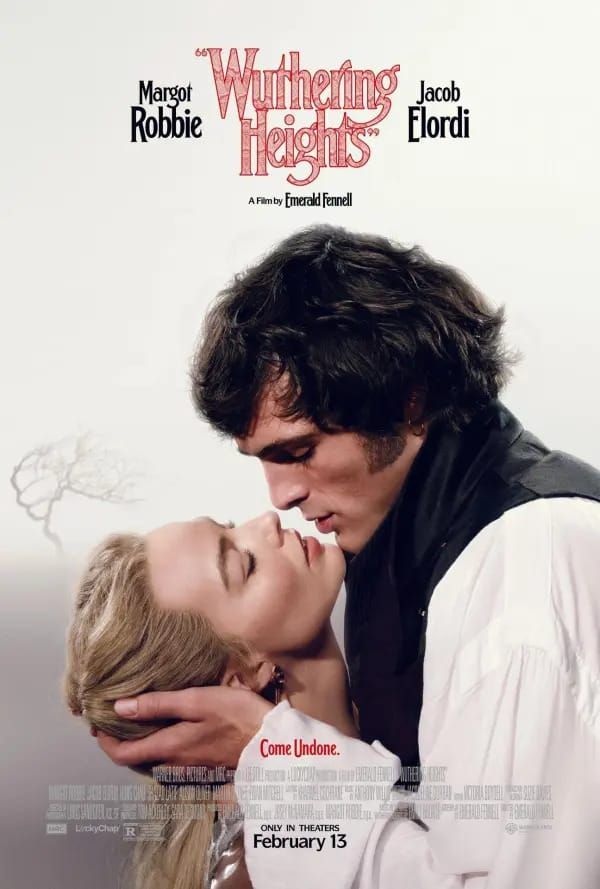
The calibre of acting in the film is incredible. Margot Robbie shows more range in this version of Cathy than she’s ever had the chance to show before in a singular film. This Cathy has to be charming and lovable, but also undeniably wicked to the core and vindictive in ways that would make Misery Chastain blush. Jacob Elordi nails every moment he’s in as outsider Heathcliff, mirroring Robbie’s Cathy until the two characters might as well be one. They're perfectly paired together in this cautionary story of love and degradation in Victorian times.
Hong Chau steals the show as Nelly. With the shifting context and focus of “Wuthering Heights,” Nelly goes from the one who knows everything to a cold villain hellbent on forcing Cathy to live the high society life she herself was never allowed because of her own lineage. She can only climb if she forces Cathy to fall in line, and Chau builds an incredibly complex and haunting character out of the struggle. Does she truly hate Cathy for Cathy’s childhood decision to replace her with Heathcliff? Or is she genuinely looking out for Cathy’s best interest? Is she, or anyone in this story, truly capable of compassion not prescribed by society? This adaptation of Wuthering Heights hinges on Nelly’s presence in a way that her observational role in the novel could never anticipate.
It’s 2026. Emerald Fennel releases her version of “Wuthering Heights,” even adding quotation marks to the title to stress that it’s a loose adaptation, not a page for page replica. For all the changes made to the characters and plot, the film could be called Withering Hills, a love story about Carol and Felix forced together and ripped apart again and again by class in Victorian England, and no one would have a reason to complain about fidelity to a 19th century novel. The source material is part of the discussion–intrinsically so–and no amount of good will stop viewers who will inevitably dislike the film for not being Wuthering Heights.
“Wuthering Heights” is currently playing in theaters.